Les Nocturnes de l’Histoire – La logistique Napoléonienne… Piour les nuls !
10500 Brienne-le-Château

Présentation
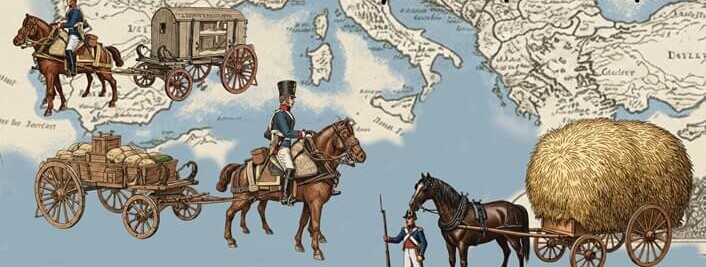
“Amateurs discuss tactics, professionals talk logistics.” For its 2026 Nocturnes, the Napoleon Museum is showcasing a little-known but essential aspect of military operations: logistics. In the collective imagination, discussing the Napoleonic campaigns means evoking Napoleon’s strategies, troop movements, and the soldiers’ fervor and bravery. While these aspects contribute to the glory of the Napoleonic epic, a crucial cog in this success is missing: logistics. It seems obvious, yet it remains largely unknown and seldom discussed because it is less glamorous than the feats of arms. This logistics, even if the term is anachronistic, can be organized, without going into all the details, into three main categories: artillery trains, supply trains, and medical services. In other words, everything a soldier needs to wage war: weapons, food, clothing, and medical care. As a skilled military leader, Napoleon understood the importance of food supplies and organized his campaigns accordingly: if provisions were insufficient, the campaign would not begin, or at least not until the necessary supplies were available. To ensure greater mobility, frugality was essential for all troops. It was estimated that the army needed an average of 18 days’ worth of supplies: 3 days’ worth of bread carried by the soldier, 6 days’ worth in the units’ supply wagons, and 9 days’ worth of flour transported by the supply train. It was also necessary to follow the columns with herds of animals, which were slaughtered gradually as needed. Furthermore, the practice was to live primarily off the enemy territory, thus reducing the need for convoys. Napoleonic logistics were optimal for campaigns against wealthy countries, such as the German Confederation, but the limits of its effectiveness became apparent in campaigns against poorer countries like Spain, or with specific tactics such as scorched earth, as seen in Russia. To improve the efficiency of this logistics system, Napoleon gradually militarized its various branches: the artillery train in 1800, the engineering train in 1806, the supply train in 1807, and finally the medical service in 1809. For its 2026 History Nights, the Musée Napoléon has chosen to make this essential logistics of Napoleon’s military campaigns accessible to all, using recently acquired dioramas being shown to the public for the first time. It is quite logical that this type of diorama is much rarer than those depicting Old Guard or cavalrymen. Logistics is often overlooked in historiography and representations, and therefore is usually underrepresented in museum collections. The proposed flash visits do not claim to present an exhaustive account of the functioning and evolution of logistics under Napoleon’s reign, but rather to popularize a complex aspect while giving a new perspective on the Napoleonic campaigns that goes beyond the usual clichés and is illustrated by these recent acquisitions of the museum.
Rates
| Free |
Horaires
Le 25/03/2026
| Horaires | 17:00 - 18:00 |
Coordonnées
- Phone : +33 (0)3 25 27 65 80
- Email : contact@musee-napoleon-brienne.fr
- Site web : https://www.musee-napoleon-brienne.fr/nocturnes-de-lhistoire
- Réseaux sociaux : Facebook
- Adresse : 34 rue de l'Ecole Militaire 10500 Brienne-le-Château